

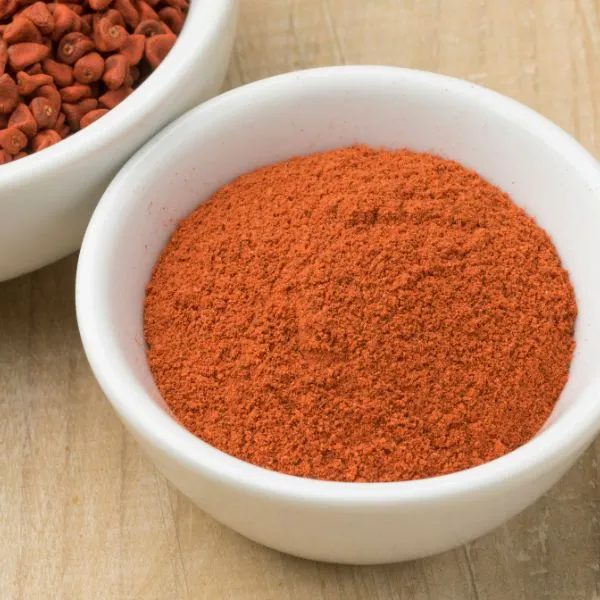
Annatto powder may be a useful natural colorant for producers seeking to add a yellow, golden or orange color to their products. But selection of the right powder is not just about appearance. The pigment concentration, application compatibility, dispersion, processing conditions, storage and the intended final shade are important factors for the formulators to consider. The choice of ingredient can be made with a careful evaluation to ensure that the selected ingredient is suitable for the formulation and will function as expected during commercial production.
Understand Annatto Powder
The seeds of Bixa Orellana yield a natural source of carotenoid pigments called annatto. The key colorants are bixin and norbixin, and their properties may affect the functional properties of the ingredient in various food matrices.
The powder format may be helpful when a manufacturer prefers a dry ingredient which can be measured, mixed, and added to the production process. Not all powders, however, will react the same. Handling and final color performance can vary with concentration, carrier materials, characteristics of the particles and application.
Match the Powder to the Application
The first thing to be considered is the food product to be developed. Products that may use Annatto color include bakery products, dairy foods, snacks, dressings, sauces and other processed foods, in which warm hues are desired.
Various formulations will have different technical requirements. An excellent powder dispersion might be required for a dry seasoning product, and a complex food matrix for a dairy seasoning.
Manufacturers should thus determine the preferred color, product ingredients, processing method, and storage conditions prior to choosing an ingredient.
Consider Color Strength
When making comparisons between Annatto Powder products, one should keep in mind the strength of the colors. If the product is more concentrated, lower amounts may be necessary, but if the product is less concentrated, higher amounts may be needed to achieve the same visual effect.
But it is important to consider not only the concentration but also make a purchase decision. Final appearance may vary after addition of powder to complete formulation.
Application testing is a superior means of comparison for products. Manufacturers can test various samples at practical dosage levels and watch the shade, uniformity and appearance of the samples.
Evaluate Dispersion and Solubility
Handling powder has the potential to greatly influence production. The powder should be uniformly distributed in the formulation without visible concentrations or uneven color.
The needed behavior will vary according to the final product: water-based, fat-based, dry or more complex food system. Technical data on dispersion and solubility should be examined prior to the start of large-scale trials by the manufacturers.
Depending on the production process and formulation, pre-mixing the powder with a suitable ingredient to achieve more uniform distribution may be necessary.
Review Processing Conditions
The performance of natural colors can be affected by processing. The final product appearance may be influenced by the following factors: heat, light, oxygen, product pH, and processing time when using annatto.
Manufacturers should, therefore, test the powder in a condition that are similar to commercial production. When the product is baked, heated, pasteurized, frozen or subjected to extended storage, these conditions should be specified during testing.
This method would be a better way to evaluate the ingredient than to make an evaluation prior to processing.
Check Storage Requirements
The physical quality or usefulness of a powdered ingredient may be influenced by the method of storage. Manufacturers should check the recommended temperature, moisture protection, packaging, shelf life and handling and be advised before purchasing.
Special attention is needed to the storage aspect where the ingredient is going to be in stock for a longer time. Having a good stock rotation system in place can also help ensure that older stocks are used responsibly.
When buying in bulk for continuous production, these considerations gain in importance.
Review Supplier Documentation
Technical documentation is used for educating the manufacturers regarding the product they are buying and how they will use it. Such data can consist of pigment concentration, recommended dosage, application instructions, storage instructions or specifications.
A supplier that offers hands-on technical assistance can assist during the formulation trial. This could be useful if you want to adjust a desired color or if you are adding the ingredient to a new product category.
Conclusion
When selecting annatto powder, it is important to consider its color intensity, formulating with other ingredients, dispersion, processing conditions, and storage requirements. One of the most effective methods for understanding the actual performance of the ingredient in the food application before scaling up to larger production volume is to test the ingredient application in the actual food product. FoodRGB.com allows manufacturers to inspect available colors and other natural food coloring ingredients, and talk to an ingredient expert about the ingredients required for their formulations.
